How filters work to control contamination

We have recently come across this rather thorough yet simple explanation of How Filters Work to Control Contamination. The article was written in 2001 but still makes for an interesting read today.

This would be a good time to expand on the test methods and the obvious one to cover today will be Particle Counting. We can offer both the Instrumental Particle Count and Optical Microscopy or “Patch Test” method (our preferred choice as it offers more detail of the debris present in the sample, including an image of the contaminants). An example of a few of the patches can be seen below.
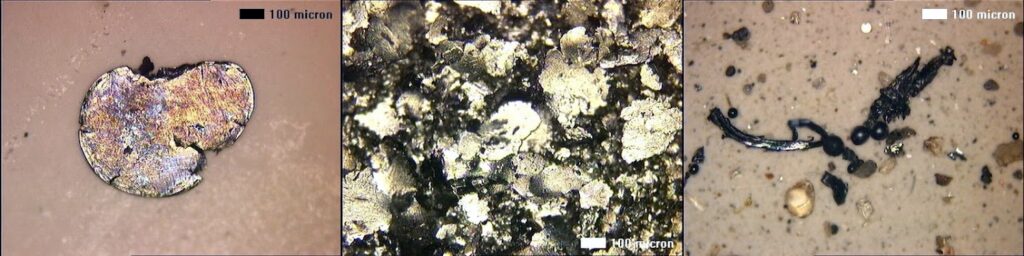
Any of these are bad news!

You may also like

  • Oil Sampling do’s and don’ts and other useful advice

    Oil Sampling do’s and don’ts and other useful advice

    We will start the articles section off with the basics Oil Sampling Do’s and Don’ts and other useful advice from the Machinery Lubrication magazine.

    Continue reading March 13th 2012
  • Tips for Reducing Wrong Oil Mistakes

    Tips for Reducing Wrong Oil Mistakes

    One of the reasons for running our virgin oil promotion was to raise awareness of issues surrounding storage and handling of new oils – in particular use of incorrect oils caused by poor procedures. The following short article from the Machinery Lubrication magazine gives simple Tips for Reducing Wrong Oil Mistakes.

    Continue reading March 23rd 2012
  • Elemental Analysis of Industrial lubricants

    Elemental Analysis of Industrial lubricants

    Continuing introduction of the key oil analysis tests offered at the lab we would like to draw your attention to this 7 minute video on Elemental Analysis of Industrial Lubricants. It covers the basic principles of elemental analysis and introduces the two types of instruments that are most commonly used.

    Continue reading March 23rd 2012