How filters work to control contamination

We have recently come across this rather thorough yet simple explanation of How Filters Work to Control Contamination. The article was written in 2001 but still makes for an interesting read today.

This would be a good time to expand on the test methods and the obvious one to cover today will be Particle Counting. We can offer both the Instrumental Particle Count and Optical Microscopy or “Patch Test” method (our preferred choice as it offers more detail of the debris present in the sample, including an image of the contaminants). An example of a few of the patches can be seen below.
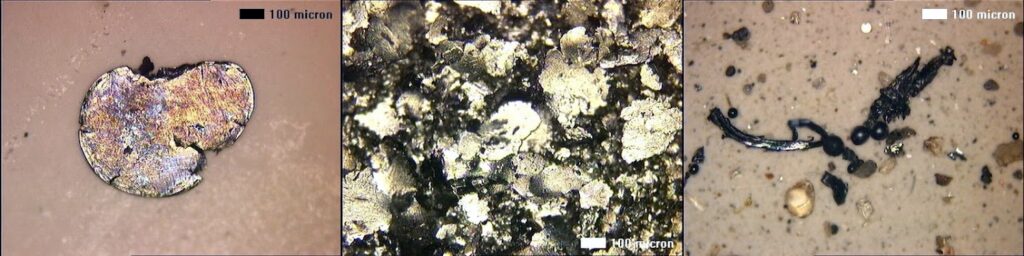
Any of these are bad news!

You may also like

  • New ICP now online

    New ICP now online

    Conversion of Aqueous ICP methodology to that with Internal Standard (IS). We are introducing an improvement into the aqueous ICP analysis by adding an Internal Standard to the test method. An Internal Standard is an additional element, that is not expected to be found in the substance being measured, which is introduced into the dilutionRead More

    Continue reading December 13th 2023
  • Tribute to Mervin Jones

    Tribute to Mervin Jones

    It is with great sadness that we announce the passing of Mervin H. Jones, the founder of Swansea Tribology Services.

    Continue reading December 23rd 2024
  • Bearings don’t just die, they are murdered

    Bearings don’t just die, they are murdered

    I just came across this incredible phrase while looking for some graphs to demonstrate… exactly that. It sounds dramatic, but it’s anything but. An estimated bearing working life is an ideal that is unlikely to be reached in practice. Read this excellent article from Machinery Lubrication for more details, then come back and send overRead More

    Continue reading July 22nd 2022